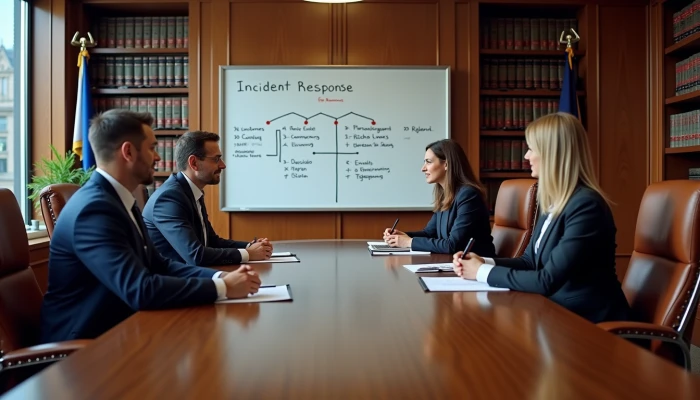
A Practical Cybersecurity Playbook for Law Firms with Small Teams
Law firms handle highly sensitive information, but many small practices do not have internal IT staff or a dedicated security lead. That creates a difficult balancing act: protect client data, support remote work, meet ethical and regulatory expectations, and still keep daily work moving.
A practical approach to small business cybersecurity can help. For law firms, that usually means focusing on a few foundational controls, documenting what is in place, and building repeatable workflows that staff can actually follow.
This guide focuses on four areas that matter in day-to-day legal operations: encrypted communication channels, incident response planning, compliance documentation, and cyber-insurance readiness. It is written for small firms and solo or lean teams that need a plain-English starting point rather than a technical overhaul.
Implementing Encrypted Communication Channels
Law firms regularly send contracts, discovery materials, financial records, medical information, and other confidential documents. That makes secure communication a basic operational need, not just a technical preference.
ABA guidance on client communications commonly emphasizes that lawyers should assess the sensitivity of information and use reasonable security measures. In practice, that means avoiding casual sharing habits when the matter involves confidential or regulated data.
A workable starting point is to review the main places where information leaves or enters the firm.
- Client portals
- File-sharing links
- Remote consultation tools
- Messaging apps used by staff
- Mobile devices used outside the office
For many small firms, the biggest improvement comes from standardizing secure channels instead of letting each person choose their own method. If one attorney sends attachments by ordinary email, another uses a portal, and a third texts documents from a phone, the firm creates unnecessary inconsistency and risk.
A simple communication policy should answer questions like these.
- Which types of documents must go through an encrypted portal or secure file-sharing process?
- When should staff avoid sending attachments directly by email?
- What tools are approved for remote meetings involving client matters?
- How should staff verify recipient addresses before sending sensitive files?
- What is the backup method if the normal communication system is unavailable?
End-to-end encryption may be appropriate for some consultations or file transfers, especially where the sensitivity of the matter is high. The key point is not to adopt every advanced option available. It is to match the communication method to the sensitivity of the information and document the firm's standard.
This is also where training matters. Staff should know that secure communication is not only about the tool itself. It also depends on routine habits such as confirming recipients, using strong account security, and avoiding personal accounts for firm business.
Use this quick workflow check to review communication practices.
| Workflow | Minimum question to answer | Documentation to keep |
|---|---|---|
| Client email | When is encrypted email required? | Written communication policy |
| File sharing | What method is approved for confidential files? | Approved workflow list |
| Remote meetings | How are sensitive consultations protected? | Meeting security standard |
| Mobile access | Can staff access client data from phones or tablets? | Device and access policy |
| Client intake | How is sensitive intake information submitted? | Intake procedure |
For small firms, consistency is often more valuable than complexity. A documented, repeatable process for secure communications is easier to train, audit, and explain during a cyber insurance application checklist or renewal review.
Developing an Incident Response Plan
Even a well-run firm can face a security incident. The practical question is whether the firm knows what to do next.
An incident response plan should not be a long technical manual. For a small law firm, it should be a clear document that tells people who is responsible, how to escalate concerns, and what steps to take when systems, accounts, or client data may be affected.
ABA and legal-sector incident planning guidance commonly points to a few core elements.
- Define who makes decisions during an incident.
- Set out steps for identification, containment, investigation, and recovery.
- Include contact details for outside help, such as legal counsel, IT support, forensic support, and the cyber insurer if applicable.
- Address client communication and notification obligations.
- Plan for communication outside the firm's normal systems if email or phones are disrupted.
Small firms often overlook role clarity. If a suspicious login alert appears, who decides whether to shut off access? If a staff member clicks a malicious link, who contacts outside support? If client data may be involved, who handles legal review and communications? These decisions are much easier when made in advance.
A practical incident response checklist for a small law firm can include the following.
- A single internal incident reporting path
- Named decision-makers and backups
- A list of critical systems and vendors
- Steps for isolating affected devices or accounts
- Guidance for preserving evidence and timelines
- A process for contacting insurance, counsel, and technical responders
- A post-incident review step to update policies and training
Legal-sector reporting has noted that many firms still do not have a formal incident response plan, with adoption especially low among solo and smaller practices. That gap matters because response quality often depends more on preparation than on firm size.
Tabletop exercises are one of the most practical ways to test the plan. These do not need to be elaborate. A 30-minute discussion around a realistic scenario can reveal missing contacts, unclear responsibilities, or communication gaps.
Here are three useful tabletop prompts.
- A staff member reports that a client received a fake invoice that appears to come from the firm.
- An attorney's email account shows suspicious forwarding rules and unusual login activity.
- A laptop used for active matters is lost while traveling.
After each exercise, capture what changed.
| Question | What to record |
|---|---|
| What worked? | Steps the team could follow without confusion |
| What failed? | Missing contacts, approvals, or tools |
| What was unclear? | Role confusion, notification questions, vendor dependencies |
| What changed? | Policy updates, training needs, documentation fixes |
For cyber insurance renewal checklist preparation, a tested incident response plan can also help show that the firm is not relying on informal reactions alone.
Compliance with ABA, GDPR, and HIPAA Standards
Law firms do not all face the same compliance obligations, but many do need to align their security practices with ethical duties, contractual requirements, and privacy rules tied to the matters they handle.
At a baseline, ABA guidance and Model Rule 1.6(c) are often used as a practical reference point for reasonable safeguards around client information. Additional obligations may apply if a firm handles data connected to healthcare, international clients, or regulated industries.
The safest practical approach is to separate three questions.
- What data does the firm hold?
- What rules or duties may apply to that data?
- What safeguards and documentation support those obligations?
This is where data mapping becomes useful. A small firm does not need a complicated compliance platform to start. It can document where client data comes from, where it is stored, who can access it, how it is shared, and how long it is retained.
A basic data mapping exercise should cover:
- Matter files and document repositories
- Email systems
- Billing and payment systems
- Intake forms
- Practice management platforms
- Staff laptops and mobile devices
- Third-party vendors with access to firm or client data
If the firm works with healthcare-related matters or receives protected health information, HIPAA-related handling requirements may become relevant. If the firm serves clients or matters involving personal data subject to GDPR, privacy and handling expectations may also expand. The exact legal interpretation depends on the firm's facts and counsel, but from an operational standpoint, the firm should know when regulated data is present and what extra controls may be needed.
Documented safeguards often include:
- Access controls for systems holding client data
- Secure communication standards
- Device security requirements
- Backup and recovery procedures
- Vendor review and access restrictions
- Staff training and confidentiality practices
- Incident response and notification procedures
Formal ABA opinions are also commonly cited for specific areas such as secure client communications, responding to breaches, remote work, and broader technology competence. For a small firm, the practical takeaway is that cybersecurity for law firms should be documented, risk-based, and tied to actual workflows.
A simple maturity review can help prioritize next steps.
| Area | Basic | Improving | Documented and repeatable |
|---|---|---|---|
| Client communications | Ad hoc tool use | Standard tools chosen | Written rules and staff training |
| Data inventory | Partial awareness | Main systems listed | Data map maintained |
| Access control | Shared habits vary | Access reviewed occasionally | Formal onboarding and offboarding steps |
| Incident planning | No written plan | Draft plan exists | Roles tested in exercises |
| Compliance evidence | Scattered records | Some policies saved | Central documentation set |
This kind of review will not create , but it helps a firm identify gaps before a regulator, client, or insurer asks for evidence.
Cyber-Insurance Readiness Frameworks
Cyber-insurance readiness is often less about buying a policy and more about being able to show that the firm has basic controls in place. Underwriters increasingly ask for evidence, not just general assurances.
For small law firms, frameworks can help organize that evidence. NIST is often used as a practical structure because it groups security work into familiar functions such as identifying assets, protecting systems, detecting issues, responding to incidents, and recovering from disruption. That does not mean every firm must implement a formal framework program. It means the framework can help turn scattered practices into a clearer record.
This is especially useful when preparing for a cyber insurance application checklist. Instead of answering each application from scratch, the firm can maintain a small set of current documents that support repeated questions.
That documentation set may include:
- A device and user inventory
- MFA status for key systems
- Backup schedule and restoration testing notes
- Incident response plan
- Security awareness training record
- Vendor access list
- Written communication and data handling policies
- Notes on privileged or regulated data categories
Many insurer questionnaires also focus on whether controls are documented and consistently applied. A firm may have backups, for example, but still struggle to answer follow-up questions if no one has recorded where they run, who reviews them, or whether recovery has been tested.
Use this readiness sequence to prepare for applications and renewals.
- List the systems that hold or access client data.
- Confirm which core controls are in place, such as MFA, backups, and endpoint protections.
- Gather written policies and operating procedures.
- Identify gaps between current practice and what the questionnaire asks.
- Assign owners and dates for closing the most important gaps.
- Save evidence in one place for future renewals.
For a cyber insurance renewal checklist, the same process applies, but with one added question: what changed since the last application? New vendors, remote staff, office moves, and practice-area changes can all affect the firm's risk profile and documentation needs.
The goal is not to claim that a framework guarantees approval. It is to make the firm's security posture easier to explain, maintain, and improve over time. For small firms with limited resources, that kind of structure can be more realistic than chasing one-off fixes every renewal cycle.
Conclusion
For small law firms, cybersecurity works best when it is tied to real workflows rather than treated as a separate technical project. Secure communications, a usable incident response plan, documented compliance safeguards, and organized insurance-readiness records all support the same core goal: protecting client information in a way the firm can sustain.
If resources are limited, start with the basics that appear across ethical guidance and insurer expectations: standardize encrypted communication channels, document who does what during an incident, map the data you hold, and keep evidence of your core controls in one place.
That approach will not eliminate every risk, and it does not replace legal, insurance, or technical advice for your specific situation. But it can give a small firm a clearer, calmer path toward stronger day-to-day security and better readiness for client, regulatory, and insurer questions.